

Jump to a section
Examining the nose and throat brings ENT clinicians close to patients and their respiratory secretions. Reusable instruments may also touch mucous membranes, the moist lining of these areas. Adenovirus offers a useful lens through which to understand why infection prevention matters at each examination.[1, 2, 5]
At Tristel, we explain the science behind infection prevention in everyday practice. Here, we look at adenovirus through the lens of ENT care, from its presence in the respiratory tract to the evidence needed for effective instrument disinfection.
What is adenovirus?
Adenoviruses are DNA viruses without a fatty outer envelope. Instead, a protein shell protects their genetic material.[1, 2]
Why structure matters
This structure is relevant to disinfection
Enveloped viruses
Have a fatty outer envelope.
Adenovirus
No envelope. A protein shell protects its genetic material.
Activity against enveloped viruses cannot automatically be assumed to cover adenovirus.[1, 2]
Where is adenovirus found?
Adenovirus can be present in the respiratory tract, including tonsils and adenoids, and may be released in respiratory secretions. Contaminated hands and objects can also carry it.
Its presence in these tissues makes it relevant to examinations of the nose and throat.[2, 3]

US study, 2025
12.5%
65 of 522 children
A US study published in December 2025 detected adenovirus DNA in tonsil tissue from 65 of 522 children, or 12.5%, undergoing elective surgery without acute respiratory symptoms. Samples were collected in 2018–2020.[3]
DNA detection alone does not establish infectious virus or transmission to another person.
What illness can it cause?
Adenoviruses commonly cause respiratory illness, from cold-like symptoms and pharyngitis, inflammation of the throat, to bronchitis or pneumonia.[1, 2]
Most infections are mild, but people with weakened immune systems or underlying cardiac or respiratory disease have a higher risk of severe illness. This article focuses on respiratory relevance to ENT care.[1, 2]
How does it spread?
Adenovirus can spread through respiratory secretions and droplets, close contact, or contact with contaminated hands and objects. In an ENT consultation, these routes are relevant to close examination, handling equipment and contact with the patient’s mucous membranes.[2]
A possible route of cross contamination
Secretions
Respiratory secretions from the patient
A hand or instrument
Secretions reach a hand or an instrument
Another contact
Relevant moments in an ENT consultation:
Close examinationHandling equipmentMucous membrane contact
Good to know
Contamination is not the same as infection
- This route applies known transmission mechanisms to ENT practice. The studies cited here do not demonstrate an outbreak involving nasendoscopes.
- Contamination means viral material is present. It does not by itself demonstrate infection in a patient.[2–4]
Why is adenovirus a microbial threat?

?Did you know?A visibly clean instrument is not a reliable guide.Find out more
Together, these features explain why visible illness and a visibly clean instrument are insufficient guides to infection prevention.[1, 2]
How can transmission be prevented?
Layers of protection
Prevention involves the whole consultation. Each layer adds to the one inside it.
Core · all patients
Standard precautions
Hand hygiene, respiratory hygiene, appropriate protective equipment, and cleaning and disinfection of shared surfaces.
When needed
Additional precautions
Additional precautions should reflect the patient’s clinical presentation and the suspected infection, following the service’s infection prevention protocol.
Complements both
Device reprocessing
Device reprocessing complements these measures.[6]

How can reusable instruments be protected?
Semicritical devices
Instruments that touch mucous membranes
Reusable instruments that touch mucous membranes are classed as semicritical and require at least cleaning followed by high level disinfection.[5]
This requirement follows the device’s intended use, including when a patient has no recognised infection. Adenovirus helps explain why evidence of appropriate viral activity matters within that process. Device compatibility and the full manufacturer’s instructions remain essential.[5]

Which EN standards matter?
European test standards help explain what a disinfectant has demonstrated. For adenovirus and reusable ENT devices, two methods are especially useful to understand.[7]

1EN 14476: suspension test
EN 14476 evaluates virucidal activity in a quantitative suspension test. Virus and disinfectant are brought together under defined laboratory conditions. It provides evidence of viral inactivation at the concentration, contact time and conditions tested.
What it doesn’t show: by itself, it does not reproduce the full reprocessing procedure on an instrument.[7]
2EN 17111: carrier test
EN 17111 evaluates virucidal activity using a carrier test for instrument disinfectants. It adds evidence from virus deposited on a test carrier, complementing suspension testing.
What it doesn’t show: it remains a standardised laboratory test rather than proof of reduced patient infections.
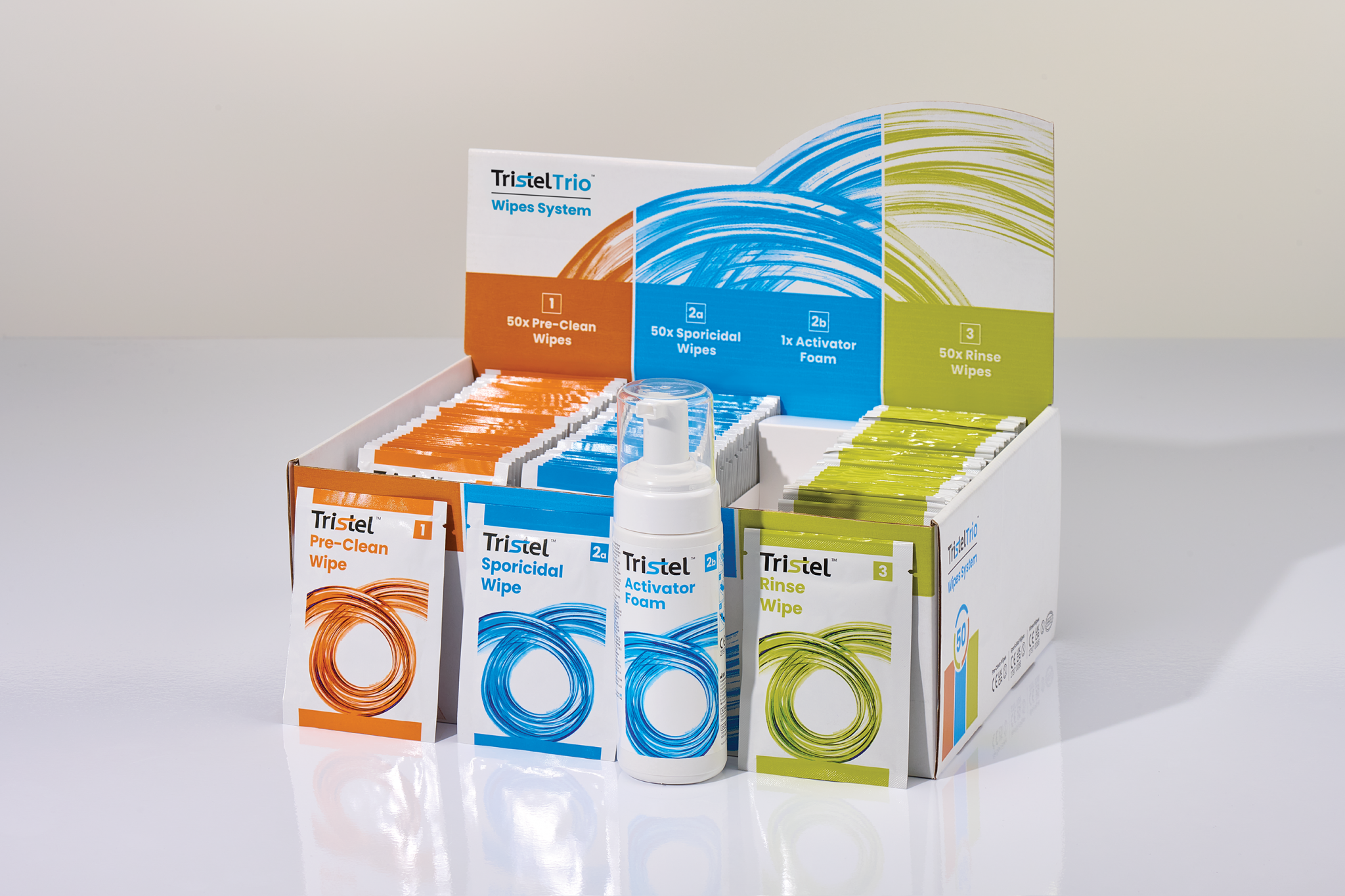
When reviewing chlorine dioxide solutions
Check the evidence for the specific formulation and process, including:
- Test virus
- Standard test method
- Contact time
- Test conditions
- Intended device use
References and further reading (9)
- CDC. Clinical Overview of Adenovirus. 16 December 2025.
- INSST. Adenovirus excepto serotipos 40 y 41. BaseBIO. Updated 7 April 2022.
- Leber AL, Xu L, Oyeniran SJ, Wang H. Molecular detection of respiratory pathogens in tonsillar tissue from asymptomatic children: implications for result interpretation among the asymptomatic and symptomatic. Microbiology Spectrum. Published 3 December 2025. DOI 10.1128/spectrum.02872-25. Samples collected April 2018–January 2020.
- Andrés C et al. The value of primary care networks for molecular surveillance of paediatric respiratory infections. Eur J Clin Microbiol Infect Dis. 2026;45:845–853. Published online 29 November 2025. DOI 10.1007/s10096-025-05353-9. Samples collected October 2021–April 2024.
- CDC. A Rational Approach to Disinfection and Sterilization. 28 November 2023, based on the 2008 guideline.
- CDC. Core Infection Prevention and Control Practices for Safe Healthcare Delivery in All Settings.
- BSI. BS EN 14476:2025. Quantitative suspension test for virucidal activity in the medical area, Phase 2 Step 1.
- Tristel. Stella System. Australian product page.
- Tristel. Trio Wipes System. Australian product page.