

The healthcare industry is a major contributor to carbon emissions and environmental waste, with 4.6% of global emissions, creating millions of tonnes of waste per year.1 A major proportion of that comes from single use items.2
One that is becoming increasingly popular is the single-use medical device.3 Driving factors include combating hospital-acquired infections (HAIs) and convenience, but using them comes with significant environmental implications.4
Single-use medical devices have seen big growth, with expectations to only get bigger.5 The increase has been driven by concerns of potential risks, a focus on reducing HAIs, patient safety and user behaviour. A systematic review of single-use and reusable medical devices the carbon footprints found that reusable devices consistently had lower lifecycle footprints.6
The single-use devices market reached $25.18 billion in 2025, and is estimated to grow to $42.43 billion by 2030.7
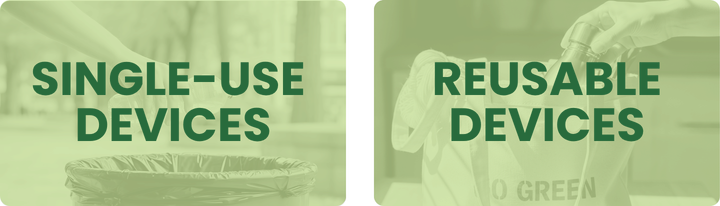
| A device intended by the manufacturer for a one-time use during a single procedure, to be discarded afterwards. | A device intended by the manufacturer for use more than once, such as a surgical instrument sterilised between uses. |
With the responsibility of balancing infection control and sustainability weighing healthcare professionals’ shoulders, it is important to know the impacts both single use and reusable devices have on the environment.
Let’s break down the findings of two recent studies.

A comparison of environmental impacts between reusable and disposable flexible laryngoscopes
Disposable laryngoscopes are fast becoming the hallmark of the linear economy or “take-make-waste” pipeline that often discounts its global impact on natural systems.
This study is the first of its kind to examine, quantify and compare the environmental impact of a single-use disposable flexible laryngoscope and a reusable flexible laryngoscope. To compare environmental impacts of the two devices, a cradle-to-grave approach was utilised (according to the ISO 14040 standard) which encompasses the following stages:
- Raw material extraction
- Manufacturing
- Transportation and distribution
- Consumer use
- Reusable reprocessing via an automated ultrasonic washer, and PPE, waste, energy and water consumption
- Single-use (energy use)
- End-of-life disposal via landfilling by regular municipal waste
What was the conclusion?
Assuming a six-year lifespan of the reusable laryngoscope and 218 laryngoscopies over year, the comparison was made over 1308 uses. This study found that using a reusable device over a single-use device showed a 31% reduction in carbon emissions, saving 804 kilograms of carbon dioxide equivalent (kg CO2e).

Figure Notes:
– Over 1308 uses, reusable emitted 1816 kg CO2e, and single-use emitted 2619 kg CO2e.
– Reusable: 62% of carbon emissions were due to PPE during reprocessing
– Single-use: 80% of carbon emissions were due to raw materials and manufacturing
As seen in the graph above, and for this study in particular, 62% of the total greenhouse gas emissions of the reusable scope were due to PPE production and reprocessing via an automated ultrasonic washer.
Notably, 80% (2095 kg CO2e) of the single-use scopes greenhouse gas emissions were attributed to scope manufacturing and production.
When comparing the two, single-use laryngoscopes had an increased environmental footprint across nine other impact categories, including:
- 14% more emissions of carcinogenic human health impacts.
- 40-50% more emissions in the categories of global warming, eutrophication, respiratory impacts and fossil fuel depletion.
- Double the impact in smog formation and acidification.
- At least 4.5 times more impact in non-carcinogenic and ecotoxicity categories.
- 96 times more (9500%) ozone-destructive emissions.
By assessing the break-even, the study determined that using a reusable laryngoscope over a single use laryngoscope produces fewer lifespan greenhouse gas emissions after only 82 uses.

Environmental footprint and material composition comparison of single-use and reusable duodenoscopes
Widespread adoption of single-use devices has greater environmental challenges and requires a balance between infection control and environmental responsibility. Carbon footprinting can help you, as healthcare providers, make sustainable choices in your healthcare practices.
This study compared sustainable strategies of three different scenarios:
- Exclusive use of a reusable duodenoscope over 1600 procedures.
- Exclusive use of single use duodenoscopes over 1600 procedures. Two different manufacturers of single use devices were used, referred to as single-use A and single-use B.
- Frequent use of a reusable duodenoscope (1405 procedures) with occasional use of single use duodenoscopes (single-use A & B) (195 procedures).
The study included the following comprehensive cradle-to-grave stages:
- Raw material extraction
- Manufacturing
- Transportation and distribution
- Consumer use
○ Single-use (energy use)
○ Reusable reprocessing via a washer-disinfector, with reagents and PPE, waste, energy and water consumption - End-of-life disposal as biomedical waste via high temperature incineration
What was the conclusion?
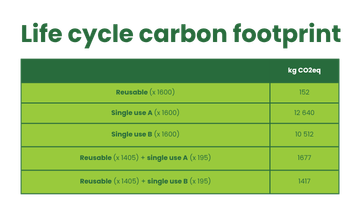
This lifecycle assessment demonstrated the sustainability of the reusable devices, with a carbon footprint of 62-82 times lower than the universal use of single-use devices, and 10 times lower than the occasional use of single-use devices.
Material composition and end-of-life
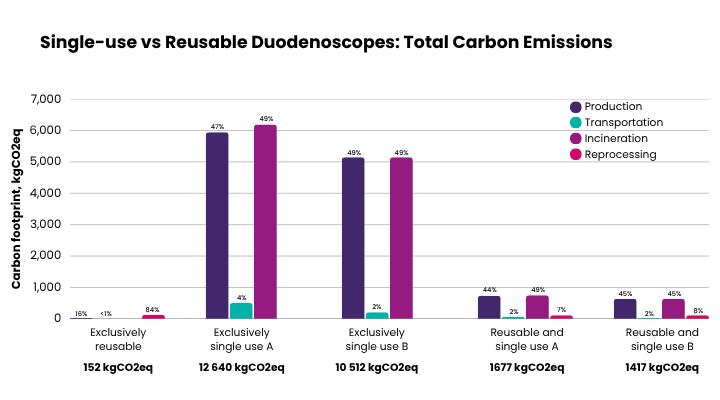
The single-use devices were mainly made of plastic polymers, while reusable devices are primarily metal components. Although reusable devices have higher manufacturing emissions, they have proved to be more environmentally friendly at end-of-life because they can be easily recycled. In contrast, single-use devices fall under the category of biomedical waste and must be sent to high temperature incineration. This process significantly amplifies pollutant emissions compared with disposal in landfill sites, producing 6176 – 5152 kg CO2e over 1600 uses.
Environmental footprint
Reprocessing is often cited as a major contributor to the economic costs and environmental footprint of reusable endoscopes and is often used to justify single-use strategies; however, this study reveals that reprocessing accounts for a small carbon footprint, 128 kg CO2e, over the lifetime of a reusable device compared to the incineration of single-use.
Based on the total carbon footprint of all scenarios (shown in the graph below), this study found both the exclusive and occasional use of single use duodenoscopes would have a significant negative impact on our environment.
Over the approximate lifetime of just one reusable device, the global adoption of single-use devices would be equivalent to producing 220,000 plastic water bottles.
In terms of greenhouse gas emissions, both footprints of exclusively single-use scenarios were equivalent to heating an apartment for three years.
Finding the balance
Keeping patients safe, making life easier for healthcare workers and looking after our planet does not have to come at the cost of the other. Single use devices have a profoundly negative influence on our environment. They may feel convenient, but our environment pays the ultimate price.
In both studies, reprocessing was the largest contributor to the carbon footprint of reusable devices, accounting for 62% and 84% of the total carbon emissions, due to the use of energy- and water-intensive methods such as automated ultrasonic washers and washer-disinfectors.
Choosing more sustainable reprocessing methods can significantly reduce your impact and you can find the perfect balance of hygiene and convenience without compromising sustainability.
For over 30 years, Tristel has stood at the forefront of infection prevention, dedicated solely to halting the transmission of microbes across environments, objects and individuals. Our cutting-edge chlorine dioxide chemistry ensures thorough disinfection, meeting regulatory requirements with a fast-acting nature and broad-spectrum efficacy. So why choose Tristel?
Effective
Tristel products utilise our propriety chemistry chlorine dioxide, effective against:
- Reducing healthcare-associated infections.
- A wide range of pathogens, including bacteria, viruses, protozoa, yeasts, fungi, mycobacteria and bacterial spores.
Short contact time, short total reprocessing time
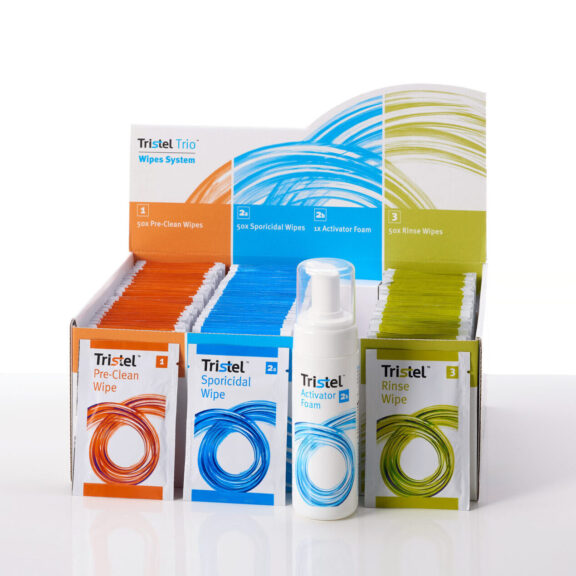
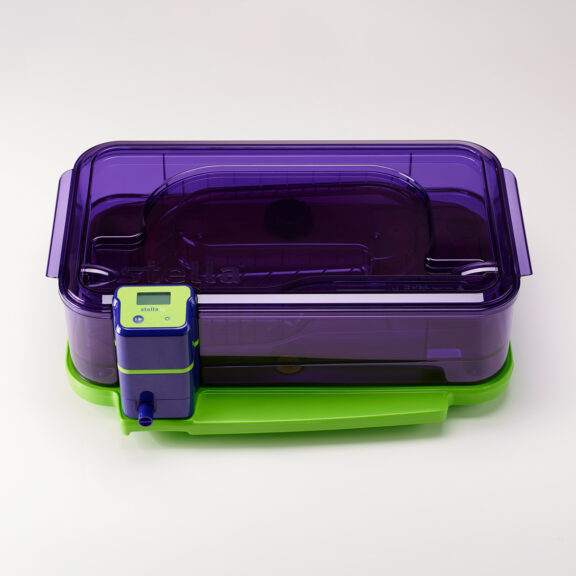
Designed with short contact times, Tristel Trio Wipes System and Stella System enables rapid high-level disinfection without compromising safety or compliance. This efficiency allows for minimal total reprocessing time.
Ease of use at point of care
Tristel Trio Wipes System and Stella System are simple to use, with clear instructions making effective disinfection easy to achieve every time. Both are lightweight and small, allowing for easy set up to be used at point of care.
The carbon footprint of Tristel Trio Wipes System
The Tristel Trio Wipes System, although at first appearing disposable, offers a lower-impact alternative. Its carbon footprint, calculated and third-party verified to ISO 14067, is substantially lower due to:
- No requirement for electricity, heating, or water
- Ease of use at the point of care
- Lightweight materials requiring minimal manufacturing processes
Overall, it presents a more environmentally sustainable reprocessing approach.
REFERENCES
1 Tee, N. C. H., Yeo, J.-A., Choolani, M., Poh, K. K., & Ang, T. L. (2024). Healthcare in the era of climate change and the need for environmental sustainability. Singapore Medical Journal, 65(4), 204–210. https://doi.org/10.4103/singaporemedj.SMJ-2024-035
2, 3, 4 Rizan, C., Mortimer, F., Stancliffe, R., & Bhutta, M. F. (2020). Plastics in healthcare: Time for a re‑evaluation. Journal of the Royal Society of Medicine, 113 (2), 49–53. https://doi.org/10.1177/0141076819890554
5 The Business Research Company. (2026). Single-use medical devices market report 2026. https://www.thebusinessresearchcompany.com/report/single-use-medical-devices-market-report
6,7 Booth, A., Chowaniec, M., Goyal, S., Faulkner, S., & Shaw, S. (2025). The carbon footprints of single-use and reusable medical devices: A systematic review. BMJ Open, 15(12), e108446. https://doi.org/10.1136/bmjopen-2025-108446