

In ophthalmology and optometry, infection prevention is critical. Eye care professionals must maintain the highest standards of hygiene to protect both patients and staff.
Microorganisms can be transmitted in several ways, through inadequately disinfected ophthalmic equipment, contaminated environmental surfaces, or direct patient to staff contact. Understanding these risks, alongside the pathogens involved, is essential to effective infection control.
This article outlines the most common ophthalmic infections and highlights the importance of high-level disinfection, including the role of chlorine dioxide in preventing transmission.
Why Infection Control Matters in Eye Care
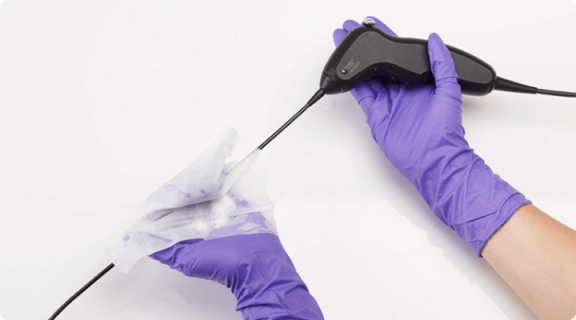
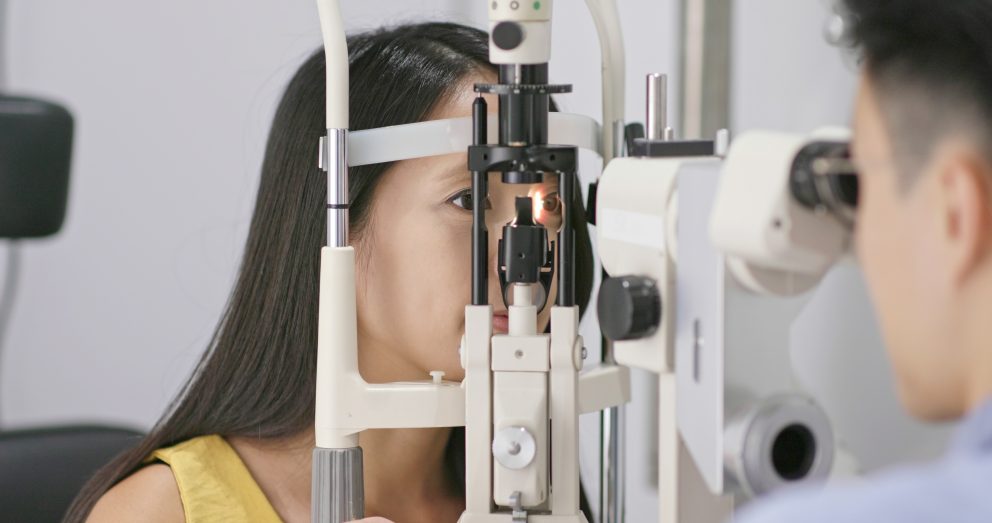
The eye is particularly vulnerable to infection due to its exposure and delicate structure. Many ophthalmic devices come into direct contact with mucous membranes, making them high risk if not properly disinfected.
Failure to follow robust infection control protocols can lead to serious complications, including sight-threatening conditions. Preventing infection must therefore remain a top priority in every clinical setting.
Common Infections in Ophthalmology and Optometry
Keratitis: A Serious Corneal Infection
Keratitis is an inflammation of the cornea that can lead to significant discomfort and vision impairment. Symptoms include:
- Moderate to severe eye pain
- Reduced vision
- Corneal ulceration
- Photophobia, light sensitivity
- Redness
It can be caused by a wide range of microorganisms, including:
- Bacteria such as Pseudomonas aeruginosa and Staphylococcus aureus
- Parasites such as Acanthamoeba spp.
- Fungi including yeasts, moulds and microsporidia¹
Acanthamoeba Keratitis, a Key Concern
Acanthamoeba keratitis is of particular concern in ophthalmology. This infection is caused by a parasite that feeds on the cornea and is commonly found in:
- Tap water
- Swimming pools
- Dust
- Contact lens accessories
These organisms can also host bacteria, protecting them from standard water treatment processes.
Acanthamoeba keratitis is often misdiagnosed as conjunctivitis or herpes simplex keratitis, which can delay treatment. If left untreated, it can cause permanent scarring or blindness³.
Early diagnosis is essential. Contact lens wearers are most at risk, accounting for approximately 85 percent of cases in the United States. Incidence rates in developed countries range from 1 to 33 cases per million contact lens users².
Adenoviral Epidemic Keratoconjunctivitis
Adenoviruses are responsible for approximately 92 percent of acute epibulbar infections. Epidemic keratoconjunctivitis, EKC, is a severe and highly contagious form of conjunctivitis, most common in late winter, spring and early summer.
Healthcare associated outbreaks are often linked to:
- Poorly disinfected ophthalmic instruments
- Inadequate hand hygiene⁴
Adenoviruses are particularly resilient:
- They remain viable on tonometer tips for up to 9 days
- They can survive on plastic surfaces for up to 35 days⁵
This environmental stability reinforces the need for effective disinfection protocols.
Endophthalmitis: A Sight-Threatening Emergency
Endophthalmitis is an inflammatory condition of the intraocular cavities caused by bacterial or fungal infection.
- Exogenous endophthalmitis occurs following trauma or surgical procedures
- Endogenous endophthalmitis spreads internally via the bloodstream⁶
Candida albicans is a common causative organism.
Although less common, this condition can result in severe vision loss. Preventing contamination is essential.
Other Infections of Concern
Additional ophthalmic infections include:
- Sty
- Uveitis
- Cellulitis
- Ocular herpes
These conditions further highlight the need for consistent infection prevention practices.This is a blogpost
The Role of High-Level Disinfection
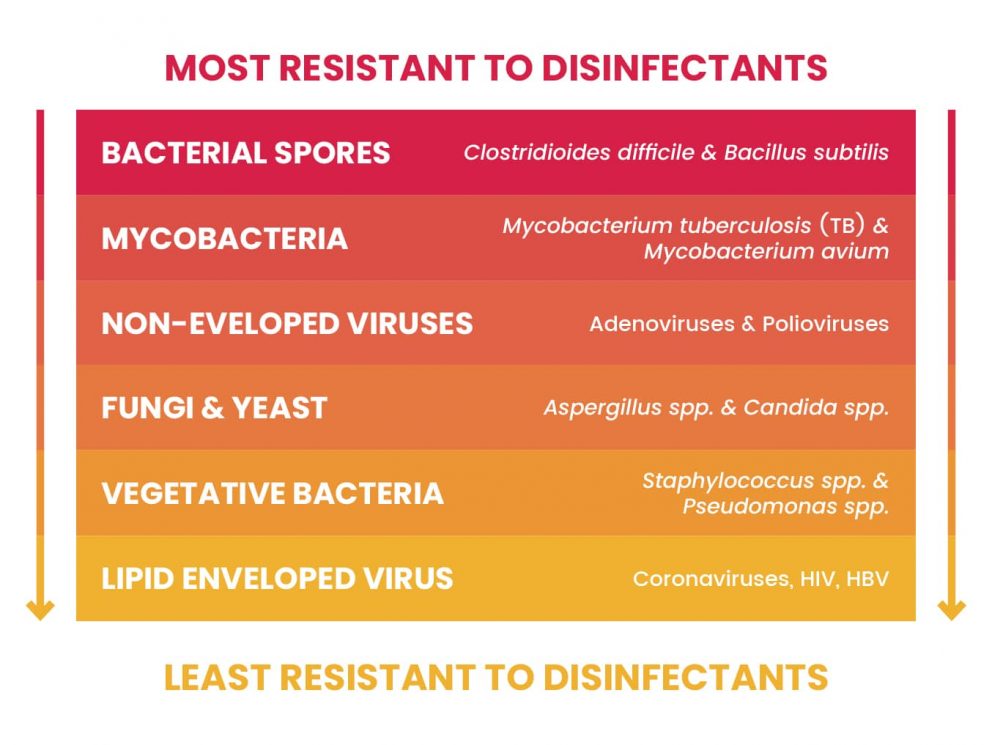
Microorganisms vary in their resistance to disinfectants. From most to least resistant, these include:
High-level disinfectants are designed to eliminate nearly all microorganisms, including bacteria, viruses, fungi, mycobacteria and small numbers of bacterial spores.
Why Ophthalmic Devices Require High-Level Disinfection
Under the Spaulding Classification, most ophthalmic instruments are considered semi critical devices because they come into contact with mucous membranes.
| Patient Contact | Device Classification | Decontamination Method |
|---|---|---|
| Intact skin | Non-critical | Low or intermediate-leve disinfection |
| Mucous membranes or non-intact skin | Semi-critical | High-level disinfection |
| Sterile areas of the body including blood contact | Critical | Sterilisation |
As a result, they require high-level disinfection between use.
Why Chlorine Dioxide
Tristel’s proprietary chlorine dioxide formulation offers broad spectrum efficacy against:
- Bacteria
- Viruses
- Fungi
- Parasites, including protozoan cysts
- Mycobacteria
- Bacterial spores
A Powerful Oxidising Biocide
Chlorine dioxide works through oxidation, disrupting microbial processes and leading to cell death.
Unlike non oxidising disinfectants such as alcohols, aldehydes and quaternary ammonium compounds, chlorine dioxide:
- Offers broad spectrum activity
- Is effective against resistant organisms
- Does not enable microorganisms to develop resistance
It has also been formulated to balance rapid efficacy with compatibility for ophthalmic devices.
Proven Efficacy Against Ophthalmic Pathogens
Tristel’s chlorine dioxide products are tested in accordance with EN 14885:2018, which provides a framework for evaluating disinfectant efficacy in medical use.
Testing against representative microorganisms demonstrates activity against a wide range of pathogens.
Virucidal Performance
Testing under EN 14476 demonstrates efficacy against key viruses, allowing effectiveness to be inferred for other pathogens, including emerging viruses such as SARS-CoV-2.
Tristel’s chlorine dioxide has been shown to inactivate SARS-CoV-2 in 30 seconds, even in the presence of organic soiling.*
Acanthamoeba Testing
As no standard testing exists for Acanthamoeba, bespoke studies have been conducted using Acanthamoeba castellanii cysts.
Due to their similarity to bacterial spores, testing followed recognised sporicidal methods, confirming efficacy against this organism.
Guidelines Supporting Chlorine Dioxide in Ophthalmology
Regulatory bodies have recognised the risk of infection transmission via ophthalmic equipment.
The Royal Australian and New Zealand College of Ophthalmologists recommends chlorine dioxide disinfectants for devices following contact with suspected or confirmed cases⁹.
Optometry Australia also states that semi-critical devices require high-level disinfection and identifies chlorine dioxide, including Tristel DUO OPH, as a gold standard option¹⁰.
Conclusion: Prioritising Prevention
Ophthalmic infections can be difficult to diagnose and may lead to serious complications.
Effective infection prevention should always include:
- Proper hand hygiene between patients
- High-level disinfection of ophthalmic devices before reuse
By implementing robust protocols and using proven disinfectants, eye care professionals can reduce infection risk and protect patient outcomes.
Tristel’s Solutions for Ophthalmology
Two chlorine dioxide high-level disinfectants are used in ophthalmic settings:
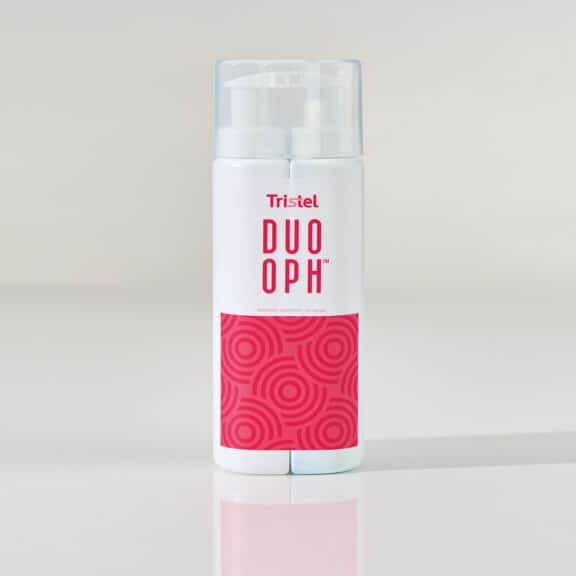
- Tristel DUO OPH, for ophthalmic devices
- Tristel JET LUX, for environmental surfaces
Both products deliver:
- Sporicidal, virucidal, bactericidal, mycobactericidal and fungicidal efficacy
- Effectiveness against Acanthamoeba cysts
- Validation through accredited laboratory testing